
Laser Gas Detector vs. Flue Gas Analyzer: A Head-to-Head Decision Guide for Industrial Buyers
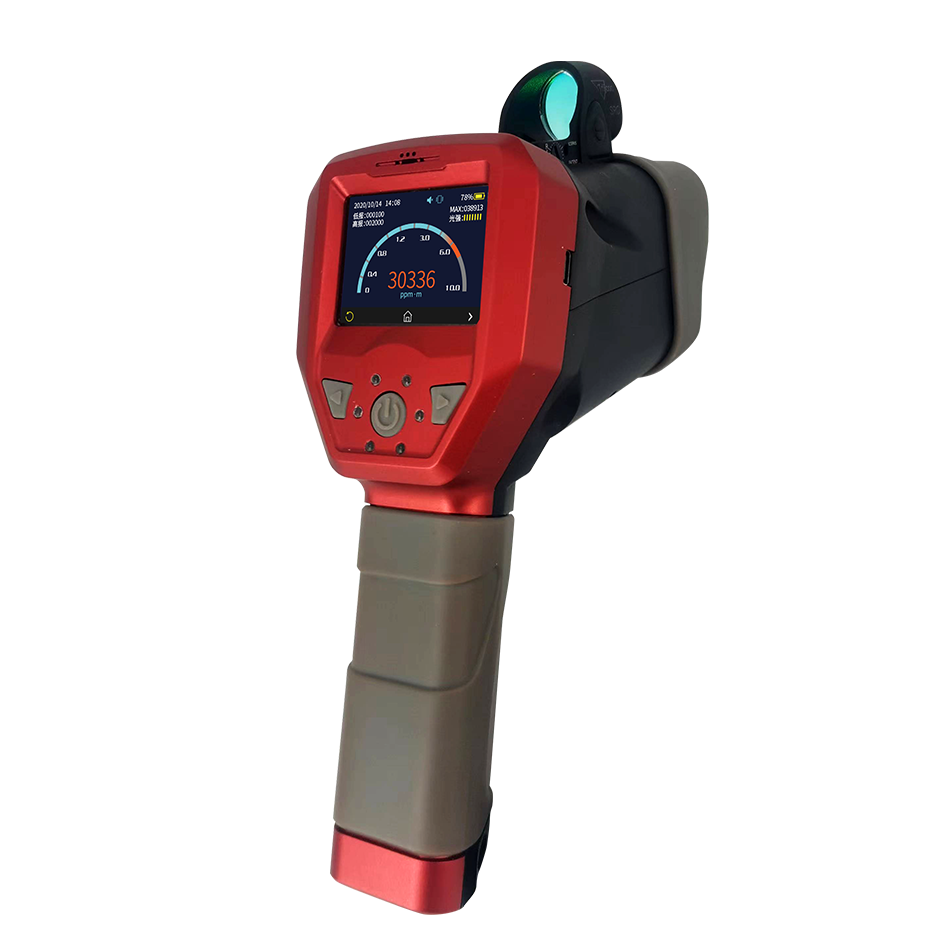
Zetron ZW-G200 portable laser gas detector — built for methane and natural gas leak detection in the field.
A laser gas detector and a flue gas analyzer are both industrial gas instruments, and both are routinely searched for under the same broad term: gas detector. They are not substitutes. A laser gas detector such as the Zetron ZW-G200 is designed to find and monitor a methane or natural gas leak in the field. A flue gas analyzer such as the Zetron MS700-FG is designed to measure combustion flue gas components — O₂, CO, NO, NO₂ and SO₂ — at a boiler, stack or incineration line.
The decision rule is straightforward: match the instrument to the monitoring objective first, then match the specification. Buyers who start from the specification sheet instead of the objective usually end up with a correctly built instrument pointed at the wrong problem.
This guide compares the two instrument families head to head using published Zetron product data, and sets out the selection steps, purchasing terms and acceptance criteria that industrial buyers can apply directly in a procurement process.
Problem Definition: Why These Two Instruments Get Confused
The confusion starts with the search term. "Gas detector" covers leak detection, personnel safety monitoring, combustion analysis and emission reporting in one phrase, and supplier catalogues frequently place all of them under a single category page. The result is a shortlist that mixes instruments incapable of doing each other's job.
Three practical failure modes follow.
- A leak survey team is equipped with a combustion analyzer. Flue gas analyzers are specified for flue gas component detection — O₂, CO, NO, NO₂, SO₂ — and use metal sampling probe parts designed for stack or boiler conditions. They are not configured for walking a pipeline route and localising a methane leak.
- An emission monitoring team is equipped with a leak detector. Laser gas detector models such as the ZW-G100, ZW-G200 and PTM600-Eg are specified for methane and natural gas leak detection. They do not report NOx or SO₂ concentrations.
- A procurement team compares specifications and concludes the two are equivalent. Accuracy, linearity, response time, protection class and explosion-proof rating look nearly identical on paper. They are — but those parameters describe performance quality, not measurement purpose.
The consequence is not only an unusable instrument. It is a compliance file that cannot be defended, a survey that has to be repeated, and a budget line that has to be spent twice.
Industry Background: Two Adjacent Markets With Different Buying Triggers
Both instrument families sit inside a growing industrial equipment category, but they are driven by different demand.
The global gas detector market was valued at USD 3.16 billion in 2023 and is projected to reach USD 4.42 billion by 2030, a CAGR of 4.9%, according to MarketsandMarkets. Within that market, the portable gas detector segment is expected to register the highest growth rate, at a CAGR of 7.8% through 2030. Asia Pacific accounted for approximately 34.1% of the global gas detection market in 2024.
The flue gas analyzer market is a separate pool of demand. Market Research Future valued it at approximately USD 2.73 billion in 2024, with a projected CAGR of 3.64% through 2035. Growth in this segment tracks emission monitoring obligations, combustion efficiency work and industrial emissions programmes rather than portable safety inspection.
Adjacent detection technologies are expanding as well, which adds another layer to buyer confusion. Photoionization detector (PID) technology is exhibiting a CAGR of 7.1%, driven by demand for high-precision detection of volatile organic compounds (VOCs), according to DataIntelo.
Two caveats matter for planning. First, published market size estimates diverge between research firms because they include different combinations of residential and industrial segments, so any single figure should be treated as directional rather than exact. Second, market growth does not tell a procurement team which instrument to specify. The trigger for a laser gas detector is a leak-risk obligation; the trigger for a flue gas analyzer is an emission or combustion-performance obligation. These come with different budget owners, different inspection routines and different acceptance tests.
One technical floor applies to both. Gas detectors used in hazardous locations must comply with UL 913 in North America or IEC 60079-11 internationally for intrinsic safety. Buyers comparing the two families should treat this requirement as a shared baseline, not a differentiator.
Detailed Solution: What Each Instrument Is Actually Built For
Laser gas detector: a field instrument for methane and natural gas leaks
Beijing Zetron Technology Co., Ltd. (Zetron) is a Beijing-based manufacturer of gas detection equipment — portable gas detectors, fixed detection systems, landfill gas analyzers, remote laser methane gas detectors and air quality monitoring systems — exporting to Southeast Asia, North America, South America and Europe. Its laser gas detector range covers three portable models, ZW-G100, ZW-G200 and PTM600-Eg, all built around the same core duty: laser-based detection of methane and natural gas leaks.
The shared technical profile across the range includes:
- Detection accuracy: high-sensitivity laser detection, typical accuracy ±2% FS
- Degree of linearity: ≤±2%
- Response time: T90 ≤20 seconds
- Power supply: rechargeable lithium battery, portable handheld operation
- Service environment: -20°C to +50°C; 10–95% RH
- Data storage: standard capacity above 10 million records, with local view, delete and data export
- Log records: calibration log, maintenance log, fault record and sensor life expiration reminder
- Interface language: Chinese and English
- Explosion-proof type: intrinsically safe Ex ia IIC T4 Ga
- Protection level: IP68
Model differences are practical rather than functional. The ZW-G100 uses a high-strength engineering plastic casing with rubber anti-slip and protective parts, and offers a standard Type-C and data export interface. The ZW-G200 adds wireless communication and a metal handle assembly, and lists energy utilities alongside natural gas, petrochemical, municipal gas pipeline, industrial safety, gas leak inspection and environmental monitoring as target industries. The PTM600-Eg is specified as a high-sensitivity laser detector for natural gas safety inspection, with an SS304 main casing and an engineering plastic probe and handle.
For a buyer, the meaningful question among these three is not which one detects better — the published accuracy, linearity and response time are identical — but which format matches the inspection routine: handheld walk-around with Type-C export, wireless data transfer, or a stainless-steel-bodied unit for harsher handling.
Flue gas analyzer: a sampling instrument for combustion and emission measurement
The MS700-FG is a different instrument with a different measurement target. It is specified as an intelligent portable flue gas analyzer for flue gas component detection covering O₂, CO, NO, NO₂ and SO₂.
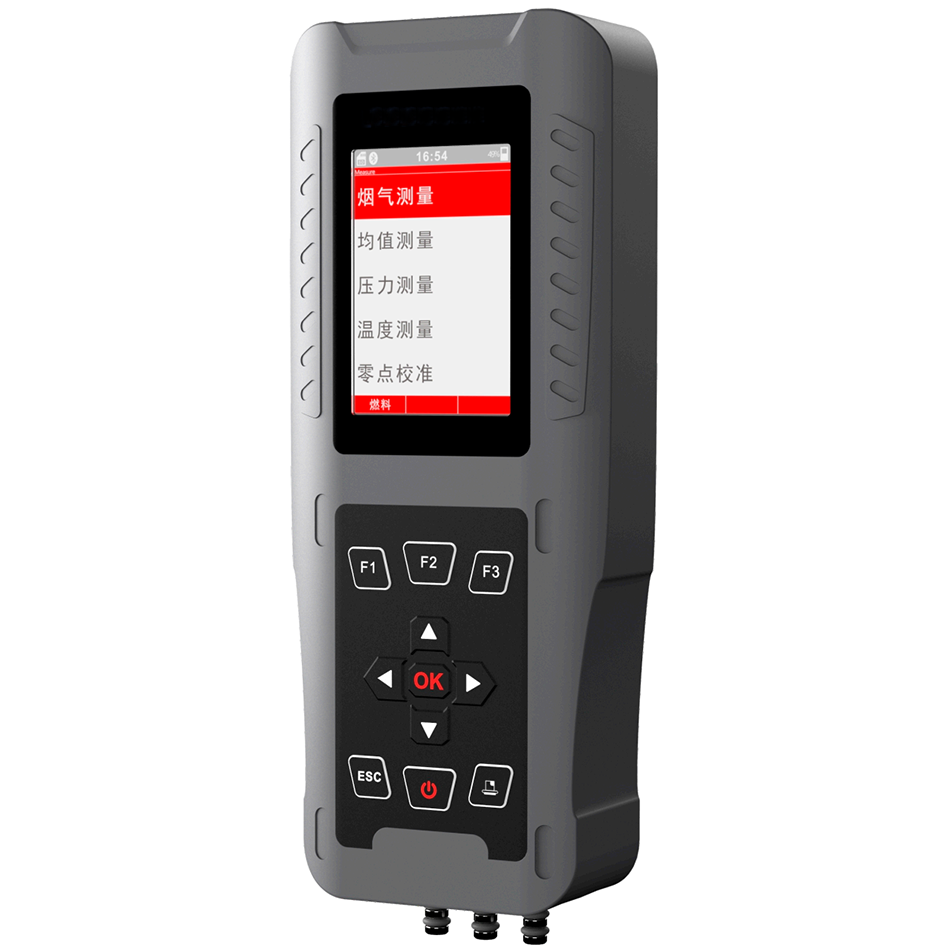
Zetron MS700-FG intelligent portable flue gas analyzer — specified for O₂, CO, NO, NO₂ and SO₂ flue gas component detection.
Its published profile:
- Detection accuracy: typical ±2% FS, with an optional 1% high-precision sensor
- Degree of linearity: ≤±2%
- Response time: T90 ≤20 seconds
- Power supply: DC3-5V rechargeable lithium battery
- Service environment: -20°C to +50°C; 10–95% RH
- Communication interface: standard Type-C and RS485
- Data storage: above 10 million records, with local view, delete and export
- Log records: calibration log, maintenance log, fault record and sensor life expiration reminder
- Interface language: Chinese and English
- Explosion-proof type: intrinsically safe Ex ia IIC T4 Ga
- Protection level: IP68
- Material: high-strength engineering plastic casing with metal sampling probe parts
Target industries listed for the MS700-FG are environmental protection, industrial emission monitoring, power plants, boilers, waste incineration and manufacturing — a set that overlaps only partially with the laser detector range.
Where the two specifications converge — and why convergence is not equivalence
Side by side, the numbers look almost interchangeable. Both families report ±2% FS accuracy, ≤±2% linearity, T90 ≤20 seconds response time, Ex ia IIC T4 Ga explosion protection, IP68 protection, above 10 million data records, the same log structure and a Chinese/English interface.
These parameters describe how well each instrument performs its own task. They say nothing about which gas or parameter is being measured. A methane leak detector and a flue gas analyzer can both be IP68 and intrinsically safe and still be unable to substitute for one another, because the sensing element and the sampling design are tied to the measurement target.
That is the single most important distinction in this comparison: the specification table tells you whether the instrument is good; the monitoring objective tells you whether it is the right instrument.
Step-by-Step Breakdown: A Selection Framework for Industrial Buyers
Step 1 — Define the monitoring objective in one sentence
Write the objective as a statement about risk or obligation, not about hardware: "detect methane leaks along a distribution network" or "measure O₂, CO, NO, NO₂ and SO₂ at the boiler outlet." If the sentence is about locating a leak, the laser gas detector family is the candidate. If it names a combustion or emission parameter, the flue gas analyzer family is the candidate.
Step 2 — List the target gases or parameters
Methane and natural gas point to the ZW-G100, ZW-G200 or PTM600-Eg. O₂, CO, NO, NO₂ and SO₂ point to the MS700-FG. Where the parameter list includes both, plan for two instruments rather than searching for a single hybrid device.
Step 3 — Fix the measurement context
Both families are specified for -20°C to +50°C and 10–95% RH, and both are IP68 and intrinsically safe. The difference is how the sample reaches the sensor: the laser detector operates as a handheld field instrument, while the MS700-FG uses metal sampling probe parts for flue gas extraction. If the measurement point is a stack, duct or boiler outlet, the sampling path determines the configuration.
Step 4 — Choose the model format
Within the laser range, the ZW-G100, ZW-G200 and PTM600-Eg share the same accuracy, linearity and response time. Select on format: wireless communication and a metal handle on the ZW-G200, an SS304 casing and probe assembly on the PTM600-Eg, or the standard handheld configuration of the ZW-G100.
Step 5 — Specify data handling and reporting
Confirm how data leaves the instrument. Both families store above 10 million records and support local view, delete and export. Interfaces differ: Type-C and a data export interface on the ZW-G100, Type-C, data export and wireless communication on the ZW-G200, Type-C and data export on the PTM600-Eg, and Type-C plus RS485 on the MS700-FG. Match this to the receiving system — RS485 for fixed integration, Type-C export for report preparation.
Step 6 — Verify certification and hazardous-area classification
Gas detectors used in hazardous locations must comply with UL 913 in North America or IEC 60079-11 internationally for intrinsic safety. The Zetron laser gas detectors and the MS700-FG are specified as intrinsically safe Ex ia IIC T4 Ga. Confirm that the certification references the exact model and configuration being quoted, because certification applies to a defined build, not to a product family name.
Step 7 — Set acceptance criteria before requesting the quotation
Write measurable criteria into the purchase specification: accuracy within ±2% FS (and the optional 1% high-precision sensor where the MS700-FG configuration requires it), linearity within ≤±2%, response time T90 ≤20 seconds, IP68 protection, Ex ia IIC T4 Ga classification, and log coverage for calibration, maintenance, faults and sensor life. Criteria agreed before the order are far easier to enforce at delivery.
Step 8 — Confirm commercial terms, lead time and support
Fix model numbers, sensor options, interface selection and documentation in the written quotation. Ask for the delivery schedule in writing, and confirm spare parts and calibration service arrangements, because the log structure in both product families assumes periodic calibration and maintenance over the instrument's service life.
Use Cases: Matching the Instrument to the Scenario
Municipal gas pipeline and distribution network surveys
A distribution operator inspecting a city network needs to find leaks, not measure combustion. The ZW-G100 provides a handheld laser detection format with data export for survey records; the ZW-G200 adds wireless communication for teams that push survey data back to a central system; the PTM600-Eg's SS304 casing suits harsher handling conditions during inspection rounds.
Natural gas, petrochemical and energy utility walk-arounds
For routine safety inspection in natural gas, petrochemical and energy utility environments, laser models are specified for real-time leak monitoring with a T90 response of ≤20 seconds. Intrinsically safe Ex ia IIC T4 Ga classification and IP68 protection allow the instrument to be used in wet, dusty or classified areas without additional housing.
Power plant and boiler combustion checks
A power plant or boiler operator needs O₂, CO, NO, NO₂ and SO₂ readings along the flue gas path. The MS700-FG is specified for this duty with metal sampling probe parts, Type-C and RS485 interfaces, and an optional 1% high-precision sensor for configurations that require tighter measurement.
Waste incineration and industrial emission monitoring
Waste incineration and manufacturing emission monitoring fall into the same family: flue gas component detection under environmental protection requirements. Storage above 10 million records, together with calibration and maintenance logs, supports the documentation trail that emission monitoring programmes require.

Waste gas treatment and emission monitoring environments are the primary deployment context for portable flue gas analyzers in industrial settings.
Environmental monitoring teams with mixed duties
Where one team is responsible both for leak inspection and for emission sampling, the practical answer is a two-instrument kit: a laser gas detector for the leak route and an MS700-FG for the flue gas path. Attempting to cover both duties with one device is what usually produces the procurement errors described at the start of this guide.
Head-to-Head Comparison Table
| Decision dimension | Laser gas detector (ZW-G100 / ZW-G200 / PTM600-Eg) | Flue gas analyzer (MS700-FG) |
|---|---|---|
| Product type | Portable laser gas detector (PTM600-Eg specified as high-sensitivity laser gas detector) | Intelligent portable flue gas analyzer |
| Primary monitoring objective | Laser-based methane / natural gas leak detection and monitoring | Flue gas component detection: O₂, CO, NO, NO₂, SO₂ and similar |
| Listed target industries | Natural gas, petrochemical, municipal gas pipeline, industrial safety, gas leak inspection, environmental monitoring, energy utilities | Environmental protection, industrial emission monitoring, power plant, boiler, waste incineration, manufacturing |
| Detection accuracy | High-sensitivity laser detection, typical ±2% FS | Typical ±2% FS, optional 1% high-precision sensor |
| Degree of linearity | ≤±2% | ≤±2% |
| Response time | T90 ≤20 seconds | T90 ≤20 seconds |
| Working power supply | Rechargeable lithium battery, portable handheld operation | DC3-5V rechargeable lithium battery |
| Communication interface | Type-C and data export (ZW-G100, PTM600-Eg); plus wireless communication (ZW-G200) | Standard Type-C and RS485 |
| Data storage | Above 10 million records; local view, delete and export | Above 10 million records; local view, delete and export |
| Log records | Calibration log, maintenance log, fault record, sensor life expiration reminder | Calibration log, maintenance log, fault record, sensor life expiration reminder |
| Interface language | Chinese and English | Chinese and English |
| Explosion-proof type | Intrinsically safe Ex ia IIC T4 Ga | Intrinsically safe Ex ia IIC T4 Ga |
| Level of protection | IP68 | IP68 |
| Casing material | ZW-G100: engineering plastic + rubber; ZW-G200: engineering plastic + metal handle parts + rubber; PTM600-Eg: SS304 main casing + engineering plastic probe and handle | High-strength engineering plastic casing + metal sampling probe parts |
Read the table in two directions. Vertically, each column describes one instrument's performance quality — and here the two are close. Horizontally, the first three rows describe what each instrument is for — and here the two are not close at all.
Purchasing Terms and Acceptance Criteria: What to Put in the Specification
A head-to-head decision is only half the work. The other half is writing a specification the supplier can be held to.
Configuration to be fixed in the quotation
- Exact model: ZW-G100, ZW-G200 or PTM600-Eg for laser detection; MS700-FG for flue gas analysis
- Sensor option: standard typical ±2% FS, or the optional 1% high-precision sensor available on the MS700-FG
- Interface selection: Type-C and data export on the ZW-G100; Type-C, data export and wireless communication on the ZW-G200; Type-C and data export on the PTM600-Eg; Type-C and RS485 on the MS700-FG
- Casing configuration: engineering plastic with rubber on the ZW-G100; engineering plastic, metal handle and rubber on the ZW-G200; SS304 with engineering plastic probe and handle on the PTM600-Eg; engineering plastic with metal sampling probe parts on the MS700-FG
- Documentation and interface: Chinese and English interface language, plus calibration, maintenance and fault log capability
Acceptance criteria to be verified at delivery
- Detection accuracy within the stated ±2% FS, or 1% where the high-precision option is ordered
- Degree of linearity within ≤±2%
- Response time T90 ≤20 seconds
- Intrinsically safe Ex ia IIC T4 Ga classification matching the ordered configuration
- IP68 level of protection
- Operating range confirmed for -20°C to +50°C and 10–95% RH
- Data storage, export and log records functional, including the sensor life expiration reminder
Commercial terms that should not be left verbal
Delivery schedule and quantity, spare parts supply, calibration and maintenance service arrangements, and the certificate set that accompanies the shipment. Zetron states that its gas detection products have acquired ATEX, CE, RoHS and FCC certification, alongside ISO9001:2005 and SGS certification for its quality system. Confirm the certificate set applicable to the exact model at quotation stage rather than assuming it applies to the category as a whole. More background on the manufacturer is available at www.zetroncn.com.
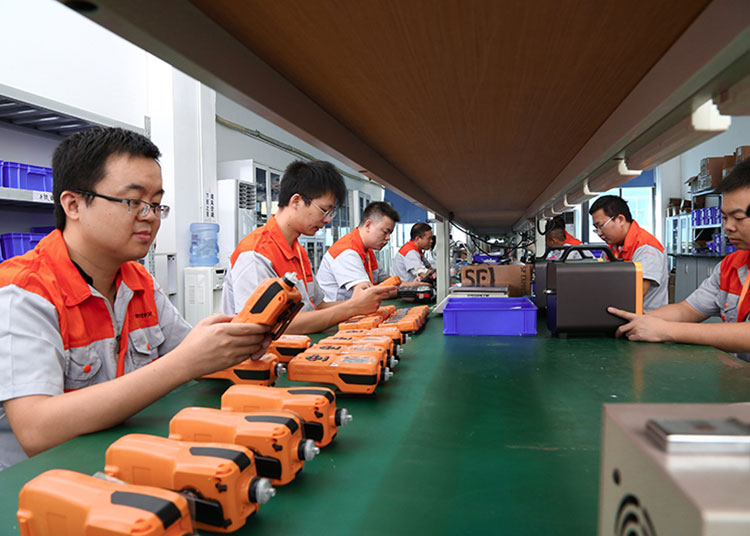
Zetron's manufacturing and quality assurance team — laser gas detectors and flue gas analyzers are produced under the same quality system.
Frequently Asked Questions
1. Do laser gas detectors and flue gas analyzers need intrinsic safety certification for hazardous areas?
Yes. Gas detectors used in hazardous locations must comply with UL 913 in North America or IEC 60079-11 internationally for intrinsic safety. The Zetron portable laser gas detector models ZW-G100, ZW-G200 and PTM600-Eg, and the MS700-FG flue gas analyzer, are specified as intrinsically safe Ex ia IIC T4 Ga with IP68 protection. Buyers should confirm that the certification documentation references the exact model and configuration on the quotation, because intrinsic safety applies to a defined build rather than to a product family name.
2. Can one instrument cover both leak detection and combustion emission analysis?
No, based on the measurement design of each product. Zetron laser gas detector models ZW-G100, ZW-G200 and PTM600-Eg are specified for laser-based detection of methane and natural gas leaks in a portable handheld format. The MS700-FG flue gas analyzer is specified for flue gas component detection covering O₂, CO, NO, NO₂ and SO₂, with an optional 1% high-precision sensor and metal sampling probe parts. A buyer responsible for both leak risk and stack emissions typically specifies two instruments rather than one.
3. What drives the cost difference between a laser gas detector and a flue gas analyzer?
In the product data used for this guide, neither instrument is priced by a single parameter, so cost should be compared configuration by configuration. The main cost drivers are the sensing principle and target gas, the number of gas channels or parameters, optional sensor upgrades such as the 1% high-precision sensor on the MS700-FG, sampling hardware such as metal probe parts, interface selection (Type-C, data export and wireless communication on the ZW-G200; Type-C and RS485 on the MS700-FG), and the certification scope attached to the ordered build. Specify required channels, interfaces and documentation before requesting quotations so that competing offers are genuinely comparable.
4. How should a buyer validate the two instruments before committing to a bulk order?
Validation should be run against the acceptance criteria written into the specification rather than against a general impression. The published reference points are typical accuracy ±2% FS, degree of linearity ≤±2%, response time T90 ≤20 seconds, IP68 protection, Ex ia IIC T4 Ga classification, an operating range of -20°C to +50°C at 10–95% RH, storage above 10 million records, and log coverage for calibration, maintenance, faults and sensor life. Test the instrument against your own target gas and your own field or flue gas conditions, then confirm data export and log retrieval work with the systems you will actually use. See the next answer for how to arrange a sample or quotation with the manufacturer.
5. What should buyers confirm about lead time and supply before ordering?
Lead time depends on the configuration rather than on the product family: the sensor option selected, the sampling probe hardware, the communication interface, the casing configuration and the order quantity all affect the build. Because these variables change from order to order, buyers should request written confirmation of the delivery schedule together with the quotation, and confirm spare parts availability and calibration service arrangements at the same time. Sample evaluation, quotation requests and delivery scheduling for the ZW-G100, ZW-G200, PTM600-Eg and MS700-FG can be directed to Beijing Zetron Technology Co., Ltd. by email at info@bjzetron.com or telephone at +86-15699785629.
Conclusion: Decide on the Objective, Specify on the Parameter
A laser gas detector and a flue gas analyzer are not alternatives to each other. They are two instruments that share a category name, a rugged housing standard and a similar performance envelope, and almost nothing else that matters.
The Zetron laser gas detector range — ZW-G100, ZW-G200 and PTM600-Eg — answers the leak-detection question: where is the methane or natural gas escaping, and how do I document that I looked. The MS700-FG flue gas analyzer answers the combustion and emission question: what are the O₂, CO, NO, NO₂ and SO₂ levels along my flue gas path.
The decision sequence that follows from this guide is short. Name the objective, list the target gases or parameters, fix the measurement context, choose the model format, specify data handling, verify certification, agree acceptance criteria in writing, and confirm commercial terms before the order is placed. Buyers who follow that sequence get the instrument their obligation actually requires — and a specification file that will still hold up when someone asks why.
Next step: request a configuration-based quotation
Tell us your monitoring objective, target gases or parameters, and site conditions, and Zetron will propose the matching model from the laser gas detector or flue gas analyzer range — together with the interface, casing and sensor options for your application.
Email: info@bjzetron.com | Tel / WhatsApp: +86-15699785629 | Website: www.zetroncn.com
Beijing Zetron Technology Co., Ltd. · 19B, Office Tower, Oriental Ginza, No.48 Dongzhimenwai Street, Dongcheng District, Beijing, China

Zetron customer service and sales office — sample requests, quotations and configuration questions are handled here.
Have Questions or Need More Details?
Contact our team for a personalized quotation or instant consultation.
Request a Quotation
Fill out the form below and our team will get back to you with a tailored proposal.
WhatsApp Direct Chat
Prefer to chat in real-time? Message us on WhatsApp for instant assistance & quick answers.
- Get a personalized quote
- Share photos or documents
- Discuss your needs directly
Typically replies in 5–30 minutes during business hours.