
Particle Counter Application Guide: Air, Liquid & Online Fit
Particle Counter Application Guide: Air, Liquid & Online Fit
Match the format to the medium and the monitoring pattern before comparing suppliers. Cleanroom air monitoring, liquid process checks and continuous online monitoring place different demands on a particle counter, and four variables decide which format fits: what is being measured, how often it must be measured, what the data has to do, and where the instrument has to live. Settle those four first, then confirm specifications, compliance documents and acceptance terms in writing.
This guide works through that sequence for the formats Zetron lists — airborne particle counters, laser airborne particle sensors, online particle sensors, liquid particle counters, intelligent particle detectors and particle analyzers — and converts the usual purchasing terms into an application-fit checklist that can travel with an RFQ.
Beijing Zetron Technology Co., Ltd., trading as Zetron, is a Beijing-based manufacturer that has focused on gas and air detection for nearly 20 years. Its range covers gas detection equipment, alarms, detectors and analyzers, online monitoring and pretreatment systems, miniature air monitoring stations, odor online monitoring systems, remote laser methane detectors, particle counters and air quality monitoring systems, together with an environmental safety monitoring cloud platform. That breadth matters to a particle counter project for a practical reason: particle data is often one channel inside a wider air-quality, HVAC or safety monitoring system, so the counter has to be able to join that system rather than report in isolation.
What application fit actually means for a particle counter
Fit is the match between four project variables and one instrument format. Any single mismatch is enough for a correctly built instrument to produce data the project cannot use.
- Medium. Particles suspended in room air, particles suspended in a liquid, or particles carried inside a process line.
- Monitoring pattern. A single verification check, a scheduled sampling round across several points, or uninterrupted monitoring at one fixed point.
- Data role. An internal trend for maintenance planning, an alarm that must trigger an action, or a record that has to stand up to an audit.
- Installation context. Carried between locations, mounted in a room or duct, or integrated with a machine or a monitoring platform.
Written down, these four answers usually remove half the catalogue. A project whose data role is an audit record, whose monitoring pattern is continuous and whose installation context is a mounted point is not a transportable-counter project, even when a transportable counter can produce a comparable number.
Starting here rather than with the datasheet matters because specifications describe how well an instrument performs its duty, not whether the duty is the right one. A fixed 2.83 L/min sensor and a transportable room counter can both be accurate and still be entirely wrong for each other's job.
Industry background: why the format question moved earlier
Particle counting sits inside several regulatory and operational frameworks at once, and each one asks for a different kind of evidence. Cleanroom classification and monitoring practice is organised around the ISO 14644 series; pharmaceutical manufacturing carries GMP expectations for controlled environments and for the records that support them; and where electronic records are used to release product, FDA 21 CFR Part 11 shapes how those records have to be controlled, traced and retained.
Zetron lists ISO 14644, EU GMP and FDA 21 CFR Part 11 among the standards against which its particle counter line is presented. The company also states that its products have passed ISO9001:2005 quality management system certification and SGS testing certification, and hold CE, RoHS, FCC and ATEX certifications. For a buyer, the useful next step is not to treat a range-level statement as a model-level one, but to ask which certificate or test report names the exact model and configuration being purchased — the check described in step 5 below.
The commercial background reinforces the same point. Zetron's stated application areas — semiconductor production, lithium battery manufacturing, chemical industry work with pure water and ultrapure water, environmental monitoring, disease control centres, food and drug testing and biopharmaceutical cleanrooms — span projects regulated in different ways and monitored at different rhythms. A biopharmaceutical cleanroom needs continuous room-air records, a pure-water loop needs a liquid check tied to a process step, and an environmental programme needs distributed points feeding one data set. No single format carries all three duties, which is why the range is split into airborne, liquid and online entries.
The six formats and the duty each one serves
The formats below are not interchangeable upgrades of one another. Each answers a different question, and the quickest way to choose is to identify which question your project is actually asking.
Airborne particle counters: room-air measurement at a defined point
An airborne particle counter draws air from a room or duct, counts and sizes the particles in a known volume, and reports a count per volume. It is the format behind cleanroom classification checks, HVAC performance verification and routine environmental monitoring, and it fits whenever the question is what is suspended in the air at a specific location at a specific time.
Zetron lists two airborne entries: the B110-Pro Airborne Particle Counter and the multi-channel B330, B550 and B1030 Airborne Particle Counter, described for environmental monitoring with a stated size range of 0.3–25 μm across multiple channels. "Multi-channel" means several size fractions are reported from the same sample; the exact channel set for each of B330, B550 and B1030 has to be read from the individual model datasheet, because the family description does not fix it.

The buyer's confirmation list for this format is short but decisive: the size channels that matter to the process, the sampling flow, whether the unit will be carried or mounted, and how the result is captured. Those four answers separate a classification tool from a monitoring instrument.
Laser airborne particle sensors: continuous fixed-point air data
The laser airborne sensor is the fixed, always-on version of the same measurement. The Zetron R210 is named as a Laser Airborne 2.83 L/min Fixed Online Particle Counter, which states three things in the model description: laser-based airborne detection, a 2.83 L/min sampling rate — approximately 0.1 cubic feet per minute, a reference flow widely used in cleanroom counting — and a fixed online format intended for mounting rather than carrying.
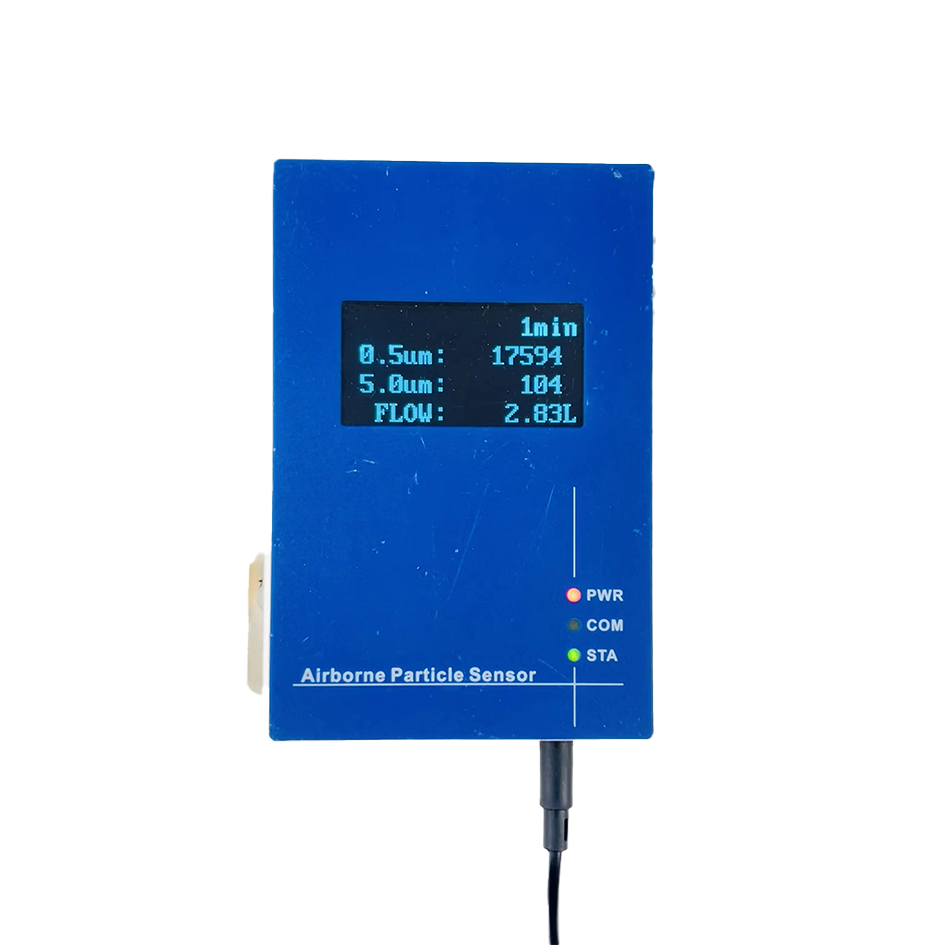
For a buyer, the meaningful distinction from a transportable counter is duty rather than accuracy: a fixed online unit is specified to run continuously at one point and pass a signal onward, while a transportable unit is specified to move between points. Confirm the mounting arrangement, alarm output and data interface instead of assuming them from the format label.
Online particle sensors: the data layer for multi-point monitoring
Online particle sensors are the building block for projects where several points must be watched at once. Zetron lists the R310P and R200 Online Particle Sensors; the supplied material does not publish per-model flow, size or interface figures, so those details belong to the technical confirmation stage rather than the format decision.
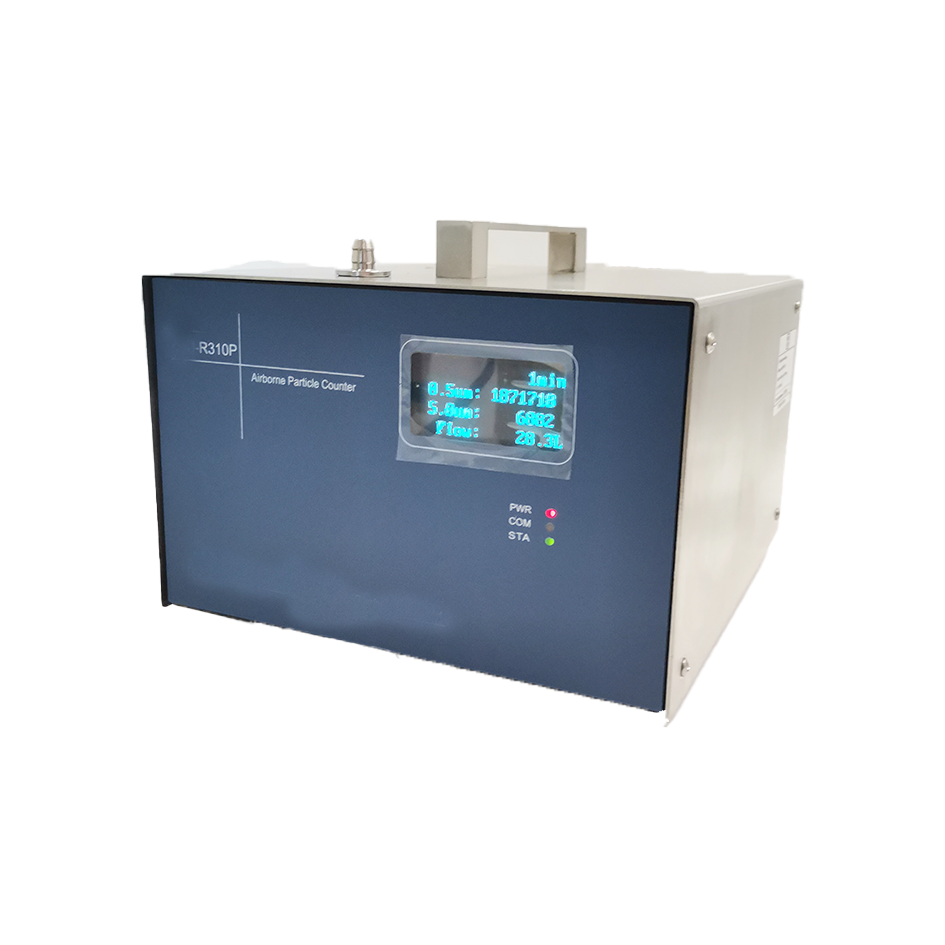
What the format decision can settle is the architecture: whether readings are pulled into a monitoring platform, whether over-limit conditions raise local alarms, and whether the site intends to add points later. Zetron describes its particle counter line as supporting real-time regional monitoring, automatic alarms when limits are exceeded, and wireless IoT integration with customizable function adaptation — precisely the attributes that decide whether an online sensor can be absorbed into an existing system or has to stand alone.
Liquid particle counters: particles in water, chemicals and process fluids
Liquid particle counting answers a different question: how many particles are suspended in a fluid rather than in the air. Zetron lists the LPC-7CE Intelligent Liquid Particle Counter, and the company's stated application areas include chemical industry work with pure water and ultrapure water, semiconductor production, lithium battery manufacturing, and food and drug testing.
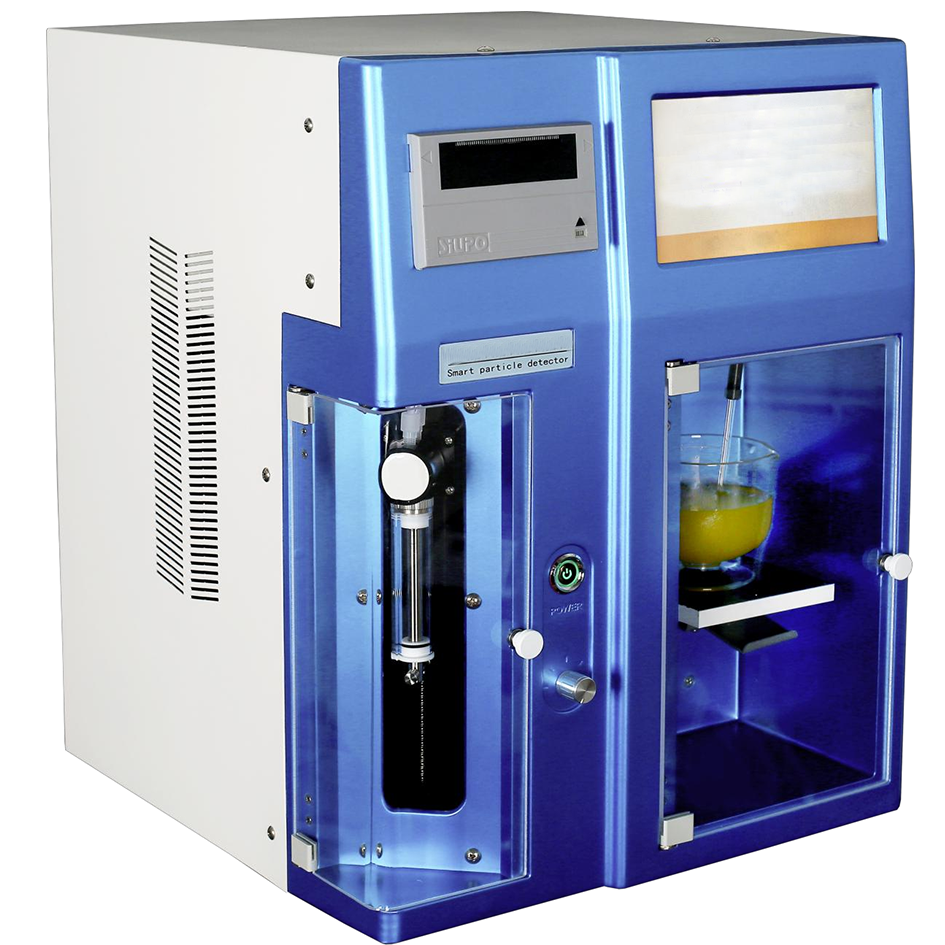
Because the medium changes, the confirmation items change with it: compatibility of the wetted path with the fluid, whether the sample is drawn from a line or from a container, and how the instrument is cleaned and validated between products. These are process questions first and instrument questions second, and they are best answered by the team that owns the fluid system.
Intelligent particle detectors: where the instrument carries detection logic
Zetron lists the LPC-16DA Intelligent Particle Detector as a separate model from its reporting counters. Where a project's requirement is closer to detection and alarming than to periodic reporting, this is the model to raise with the supplier at the technical stage, and its measurement medium, interface and alarm behaviour should be confirmed in writing before it enters a specification or a purchase order.
The reason to treat the detector role as its own decision is that detection and reporting place different demands on an instrument. A reporting counter is judged on the traceability of its record; a detector is judged on whether it flags the condition the process needs to act on, and how that flag reaches the people who act.
Particle analyzers: when the air data itself is the deliverable
The H630 Particle Analyzer is described by Zetron for precision air monitoring in medical facilities. An analyzer format suits projects where the air measurement is the point of the exercise — a facility that must demonstrate air quality in a documented way, rather than only close a control loop or confirm a classification once.
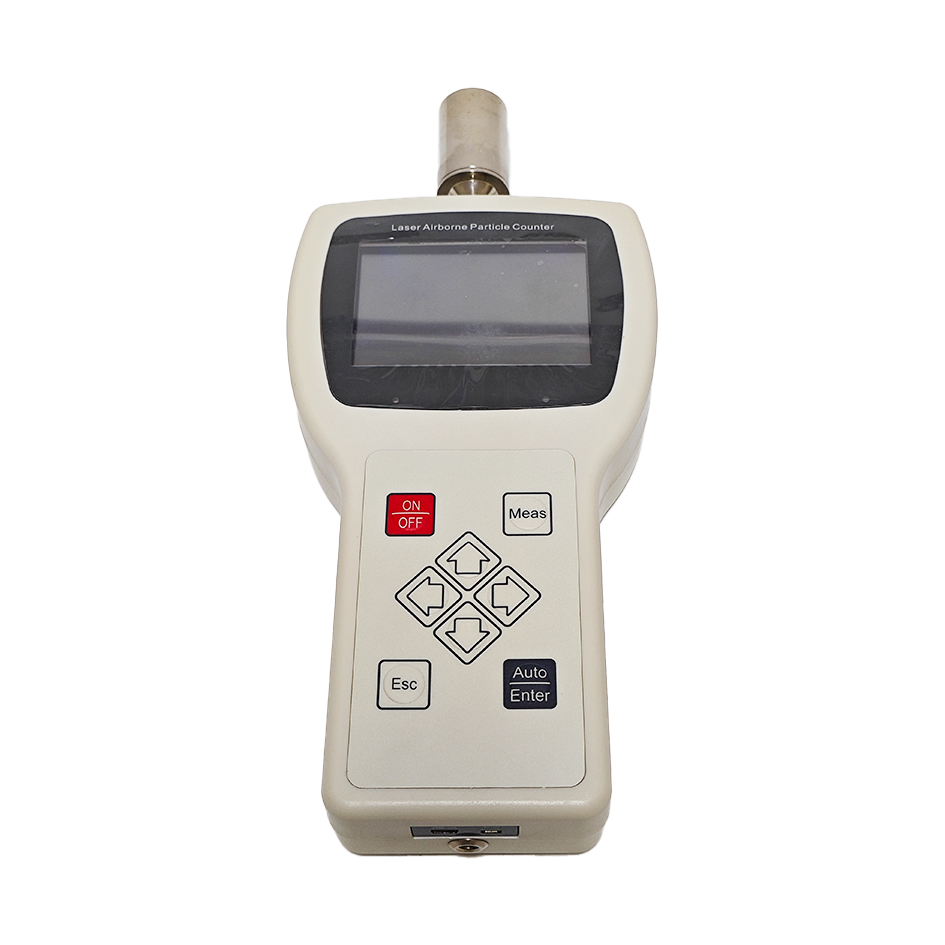
Confirming an analyzer means agreeing the output first: the report format, the interval at which data is produced, and who reads it. Those three answers determine whether the analyzer is a good fit or whether a simpler counter with a printer would have covered the requirement.
Mapping table: project scenario to counter format
Use the table as a first-pass filter. It narrows the format discussion to one or two candidates; it does not replace the technical confirmation of any individual model.
| Project scenario | Measurement target | Format that fits | Zetron model listed | Confirm in writing |
|---|---|---|---|---|
| Cleanroom classification or periodic room-air checks | Airborne particles at defined locations | Airborne particle counter | B110-Pro; B330, B550, B1030 (0.3–25 μm, multi-channel) | Size channels, sampling flow, report output |
| Continuous cleanroom or HVAC monitoring | Airborne particles at fixed points | Laser airborne sensor in fixed online format | R210 (2.83 L/min) | Mounting, alarm output, data interface |
| Multi-point or regional air monitoring | Distributed airborne data feeding one dataset | Online particle sensors | R310P; R200 | Protocol, power supply, platform integration |
| Pure water, ultrapure water or process fluid checks | Particles suspended in liquid | Liquid particle counter | LPC-7CE | Fluid compatibility, sampling method, cleaning routine |
| Detection-oriented monitoring | Particle condition that must be flagged | Intelligent particle detector | LPC-16DA | Medium, interface, alarm behaviour |
| Facility air data as a documented deliverable | Precision air monitoring in medical facilities | Particle analyzer | H630 | Report format, output interval, service scope |
Step-by-step: building the application-fit checklist
Step 1 — State the measurement, not the product
"We need a particle counter for the cleanroom" cannot be quoted accurately. Rewrite it as a measurement statement: the medium, the number and location of measurement points, the size fractions that matter to the process, and whether the result will be compared against a classification limit or tracked as a trend. This statement does more to filter the catalogue than any other single document.
Step 2 — Fix the monitoring pattern and duty cycle
Continuous, scheduled round or on demand. Continuous duty points toward the fixed online and sensor formats, a scheduled round points toward airborne counters that can be moved between locations, and on-demand checks usually point to the simplest format that produces a defensible record. Writing the duty cycle into the RFQ prevents a transportable unit from being specified for a job that assumes unattended operation.
Step 3 — Decide what the data has to do
Trend, alarm or record. This choice drives how much on-instrument reporting matters. Zetron describes its particle counter line as producing results within 3 seconds, with automatic alarms for over-limit conditions, an LCD touchscreen, and a built-in printer for instant test reports. Those attributes matter most where a reading must be captured and circulated on the spot, and matter less where the sensor's job is to feed a platform that handles reporting centrally.
Step 4 — Check the interface and the physical environment
Confirm how the reading leaves the instrument, how the alarm reaches an operator, how the unit is powered, and how it is mounted or carried. Zetron's stated support for wireless IoT integration and customizable function adaptation is relevant here, because it determines whether a non-standard interface requirement can be accommodated by the supplier rather than engineered around on site.
Step 5 — Match the compliance document to the model, not the range
ISO 14644, EU GMP and FDA 21 CFR Part 11 statements are most useful when they are attached to the model and configuration you are buying. The same applies to ISO9001:2005, SGS testing, CE, RoHS, FCC and ATEX certification: a management-system certificate that covers a manufacturing operation is not the same document as a test report for a specific unit. Ask for the certificate number and the model scope, and record both in the order file.
Step 6 — Write acceptance criteria into the purchase order
Acceptance is where format decisions become contractual. Define the conditions of the acceptance test, the deliverables that come with the unit, who performs installation and commissioning, and what maintenance support is included. Zetron describes a full-chain OEM/ODM service that runs from needs diagnosis and solution design through installation, commissioning and maintenance support, which is the part of the offer to spell out in the order rather than assume.
Three project walk-throughs
Biopharmaceutical cleanroom. A room-air project usually needs two layers of instrument. Periodic classification and investigative checks suit an airborne counter with the relevant size channels, such as the B330, B550 or B1030 multi-channel series; continuous coverage of critical points suits a fixed online format such as the R210. Where the facility must present air data as a documented deliverable, the H630 analyzer format belongs in the discussion. The format split, not the brand, is what stops a room from being covered twice in one place and not at all in another.
Pure water and process fluids. A semiconductor or lithium battery project that monitors water quality is a liquid particle question, and the LPC-7CE is the relevant counter in the supplied range. The project team should decide sampling points, fluid compatibility and cleaning between products before the instrument is selected, since those three answers constrain the installation more than the counter itself.
Distributed environmental or facility monitoring. When several rooms, zones or outdoor points feed one dataset, the sensor layer does the work. R310P and R200 online particle sensors belong to this scenario, with the platform, alarm routing and expansion plan agreed first. Adding points later is a design decision, not a purchase-time surprise, and the architecture conversation is the place to settle it.
Limits and trade-offs to keep visible
The range covers air and liquid, but not in one instrument. Zetron describes comprehensive monitoring that covers air and liquid pollution, which describes the portfolio rather than a single device. A liquid particle counter does not substitute for an airborne counter, and a project that needs both needs two formats.
Model names are not specifications. Where a name carries a figure — 2.83 L/min on the R210, 0.3–25 μm and multi-channel on the B330, B550 and B1030 — that figure is a starting point, not a full datasheet. Flow, channel configuration, interface and reporting behaviour must be confirmed per model before they enter a specification document.
Certification has a scope. A CE, RoHS, FCC or ATEX mark, an SGS testing record or an ISO9001:2005 certificate supports the claim it makes and no more. Buying decisions that depend on a specific standard should cite the document that names the model.
Customization shifts validation responsibility. Custom function adaptation and OEM/ODM work make a unit fit a project more closely, and they also mean the buyer should define who validates the customized behaviour. Agreeing that in advance is cheaper than discovering it at acceptance.
Format comparison at a glance
| Format | Duty it fits | Zetron model listed | Main trade-off to confirm |
|---|---|---|---|
| Airborne particle counter | Room-air checks, classification support, environmental monitoring | B110-Pro; B330, B550, B1030 | Portability versus fixed mounting, and the required size channels |
| Laser airborne fixed online counter | Continuous monitoring at a fixed point | R210 (2.83 L/min) | Installation effort versus uninterrupted data |
| Online particle sensor | Multi-point monitoring inside a wider system | R310P; R200 | Integration depth: standalone reading versus platform data |
| Liquid particle counter | Water, ultrapure water and process fluid checks | LPC-7CE | Fluid compatibility and sampling method |
| Intelligent particle detector | Detection-oriented duty (confirm the role in your process) | LPC-16DA | Medium, interface and alarm behaviour |
| Particle analyzer | Precision air monitoring where documented data is the deliverable | H630 | Report format and the service scope behind it |
Frequently asked questions
Which standards should a GMP cleanroom particle counter be documented against?
Zetron lists ISO 14644, EU GMP and FDA 21 CFR Part 11 among the standards its particle counter line is presented against. Because those references sit at range level, the buyer should request the certificate or test report that names the specific model and configuration, then file that document with the equipment record. ISO 14644 relates to cleanroom classification and monitoring practice, EU GMP relates to pharmaceutical manufacturing expectations for controlled environments, and FDA 21 CFR Part 11 relates to the control of electronic records — so the document you need depends on which of those the project is actually answering to.
Can one particle counter cover both air and liquid monitoring in the same project?
No. Airborne and liquid measurements use different formats, and Zetron's range is organised accordingly: airborne counters such as the B110-Pro and the B330, B550 and B1030 series for room air, the LPC-7CE for liquids, and online sensor models such as the R310P and R200 for continuous monitoring. The company's statement that its monitoring coverage spans air and liquid pollution describes the portfolio, not a single instrument. A project that needs both media should plan for two formats and two sets of confirmation items.
What drives the cost difference between a transportable airborne counter and a fixed online sensor?
Four drivers usually dominate. The first is duty: continuous operation at a fixed point carries different engineering and installation requirements from intermittent use. The second is integration: an online sensor has to connect to a platform, an alarm path or a control system, and that work has a cost independent of the instrument. The third is on-instrument reporting — Zetron describes its line as including an LCD touchscreen, a built-in printer for instant test reports and automatic over-limit alarms, features that matter more in some projects than others. The fourth is customization, since function adaptation and OEM/ODM work change both the unit and the validation effort. Prices themselves are configuration-specific and belong in a written quotation rather than in a planning assumption.
Can a buyer validate a unit before committing to a full order?
Validation should be framed as a defined step rather than an informal trial: agree which model and configuration is being evaluated, which measurement points it will run at, what result counts as a pass, and who signs it off. Zetron's stated OEM/ODM process begins with needs diagnosis and solution design before installation, commissioning and maintenance support, which gives a buyer a natural point to confirm fit before volume commitment. Put the trial scope and the acceptance criteria in writing so the outcome is comparable across candidate suppliers.
How should lead time and delivery be handled in the purchase order?
Lead time is configuration-specific and should be confirmed in the quotation for the exact model, options and customization requested, not inferred from a catalogue description. Write three things into the order: the delivery milestone for the configured unit, the installation and commissioning scope if the supplier is providing it, and the maintenance support arrangement that follows. Buyers who want to close the loop quickly can send their measurement statement, target model and required delivery window to Zetron at www.zetroncn.com or info@bjzetron.com and ask for a configuration-specific quotation with the acceptance criteria attached.
Conclusion
The format decision is a project decision, not a catalogue decision. State the medium, the monitoring pattern, the data role and the installation context, and the six formats separate quickly: airborne counters for room air, laser airborne fixed online units for continuous points, online sensors for distributed monitoring, liquid counters for process fluids, detectors where detection logic matters, and analyzers where documented air data is the deliverable.
The purchasing terms then do a second job. Compliance scope, interface detail, reporting behaviour, acceptance criteria and lead time all belong in the RFQ and the order, written against the model rather than the range. A supplier who can answer those five items specifically — as Zetron's documented model range allows — is easier to compare than one who answers only with a product category.
Next step: take the four-variable statement from this guide, attach your acceptance criteria, and send it with a request for a sample discussion or a configuration-specific quotation so the format and the model are confirmed against the same document.
Have Questions or Need More Details?
Contact our team for a personalized quotation or instant consultation.
Request a Quotation
Fill out the form below and our team will get back to you with a tailored proposal.
WhatsApp Direct Chat
Prefer to chat in real-time? Message us on WhatsApp for instant assistance & quick answers.
- Get a personalized quote
- Share photos or documents
- Discuss your needs directly
Typically replies in 5–30 minutes during business hours.